
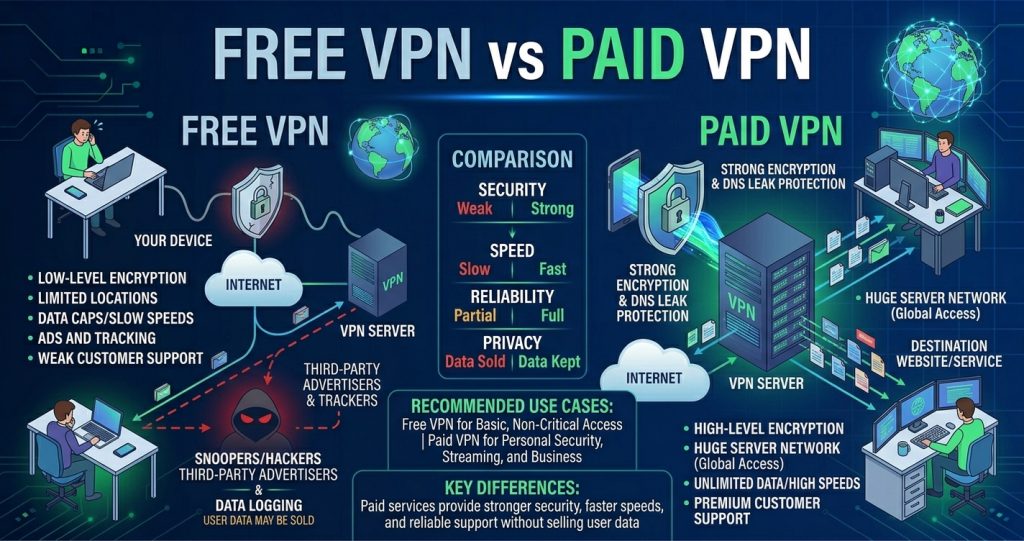
Free VPN vs. Paid VPN
Table of Contents
- The Real Question: What Does “Free” Actually Cost You?
- How Free VPNs Make Money
- The Security Reality of Free VPNs
- Research and Evidence: What Studies Actually Found
- Privacy Policies: What Free VPNs Actually Say
- Technical Limitations of Free VPNs
- Encryption and Protocol Standards: Free vs. Paid
- Server Networks: Scale, Speed, and Access
- DNS Leak and Kill Switch Protection
- Streaming and Geo-Unblocking Performance
- Torrenting and P2P Support
- Free Tiers from Reputable Paid Providers
- What Paid VPNs Actually Provide
- Independent Audits: The Gold Standard
- Cost Breakdown: What You Get Per Dollar
- When a Free VPN Is Acceptable
- When You Absolutely Need a Paid VPN
- Top Paid VPN Providers: An Honest Comparison
- Frequently Asked Questions
1. The Real Question: What Does “Free” Actually Cost You? {#real-question}
When something is free on the internet, the standard wisdom applies: if you’re not paying for the product, you are the product. Nowhere is this more consequingly true than with VPNs.
A VPN requires real infrastructure: servers in dozens or hundreds of countries, bandwidth measured in petabytes, network operations teams, software engineers maintaining client applications, and security researchers defending against vulnerabilities. This infrastructure is not free to operate. A VPN provider with no revenue stream has only two options: shut down, or monetise something other than subscriptions.
That “something else” is almost always your data.
This guide does not argue that all free VPNs are criminal operations — they aren’t. But it does make a clear-eyed assessment of what you sacrifice when you choose free, what the evidence actually shows about free VPN behaviour, and the specific circumstances in which a free VPN is and isn’t acceptable.
For a foundational understanding of what a VPN is before evaluating your options, see: What Is a VPN?
2. How Free VPNs Make Money {#how-free-vpns-make-money}
Understanding the business model is the first step to understanding the risk. Free VPN providers use one or more of the following monetisation strategies:
Data Brokering
The most common and most damaging model. The VPN logs your browsing activity — the sites you visit, search queries, time spent, app usage, device identifiers — and sells this data to advertising networks, data brokers, and market research firms.
Your browsing history is extraordinarily valuable. Data brokers sell individual browsing profiles for use in targeted advertising, insurance risk assessment, employment screening, and political micro-targeting. A free VPN that logs and sells this data is more invasive than simply using no VPN at all — because it also has your real IP address, your device identifiers, and all your traffic flowing through its infrastructure simultaneously.
In-App and Injected Advertising
Free VPN apps frequently display advertisements within the app interface. More aggressively, some proxy and VPN services have been found to inject advertisements into web pages you visit — inserting ad code into HTTP responses before they reach your browser. This is both a privacy violation and a security risk, as injected code can be used to deliver malware.
Bandwidth Reselling
One of the most alarming monetisation strategies discovered in free VPN services. The Hola VPN case is the canonical example: Hola, which had tens of millions of users, operated as a peer-to-peer network that used other users’ bandwidth as exit nodes. Hola sold this bandwidth commercially through its sister service Luminati (now Bright Data).
This means that when you used Hola’s free VPN, other people’s traffic was being routed through your internet connection — and your IP address appeared as the origin for whatever activity they were conducting. In 2015, Hola was used to conduct distributed denial-of-service (DDoS) attacks against the website 8chan through its unwitting user base (8chan statement, 2015).
Premium Upselling
Many legitimate freemium VPNs (ProtonVPN, Windscribe, TunnelBear) offer free tiers specifically to demonstrate value and convert users to paid plans. This model aligns provider incentives with user experience — the free tier must be genuinely good enough to persuade you to upgrade, but limited enough that premium features remain attractive. This is the most benign free VPN business model.
Selling to Third Parties or Governments
In several documented cases, free VPN services have been found to have connections to Chinese state-affiliated entities or to share user data with government agencies. The implications for users in politically sensitive contexts are severe.
3. The Security Reality of Free VPNs {#security-reality}
The security problems with free VPNs extend far beyond data logging. Multiple independent studies have found active security threats — not just passive privacy risks — in widely used free VPN applications.
Malware Distribution
A landmark 2016 study by researchers at CSIRO (Australia’s national science agency) and the University of New South Wales analysed 283 Android VPN apps from the Google Play Store. Their findings were alarming:
- 38% of free VPN apps contained malware — including trojans, adware, and spyware (Ikram et al., 2016 — IEEE Security & Privacy)
- 18% did not encrypt user traffic despite claiming to do so
- 84% leaked user traffic — including IPv6 traffic and DNS queries
- 16% intercepted and modified traffic
This was not a study of obscure, unknown apps — many of the offending applications had millions of downloads and high user ratings.
SSL Inspection and Traffic Manipulation
Several free VPN and proxy services have been found to conduct SSL inspection — intercepting encrypted HTTPS connections, decrypting the content, inspecting it (or injecting code), and re-encrypting it before forwarding to the user. From the user’s perspective, the connection appears secure. In reality, the VPN provider is reading every “encrypted” request.
SuperVPN — at one point one of the most downloaded VPN apps in the world with over 100 million Google Play installs — was found to contain serious security vulnerabilities exposing user data and to redirect user traffic to unintended destinations (VPNpro, 2020).
DNS Hijacking
Some free VPN services redirect DNS queries to their own servers and manipulate the responses — returning fraudulent IP addresses for legitimate domains (for advertising or phishing purposes), or inserting tracking parameters into web requests.
Man-in-the-Middle Positioning
By routing all your traffic through their infrastructure without transparent encryption, free VPNs place themselves in a perfect position for man-in-the-middle attacks. Whether they exploit this position depends entirely on their business ethics — which the evidence suggests should not be assumed.
4. Research and Evidence: What Studies Actually Found {#research-evidence}
The criticism of free VPNs is not theoretical. It is grounded in peer-reviewed research, investigative journalism, and documented incidents.
CSIRO Study (2016)
The most comprehensive academic analysis of free VPN apps. Key findings across 283 Android VPN apps:
- 18% failed to encrypt user traffic
- 38% contained malware signatures
- 84% leaked user information (DNS, IPv6, or WebRTC)
- 75% used third-party tracking libraries
- 82% requested permissions for sensitive device data (location, SMS, camera, contacts) unnecessary for VPN functionality
Citation: Ikram, M., Vallina-Rodriguez, N., Seneviratne, S., Kaafar, M. A., & Paxson, V. (2016). An Analysis of the Privacy and Security Risks of Android VPN Permission-enabled Apps. Proceedings of the 2016 Internet Measurement Conference. (arxiv.org/abs/1606.05817)
Top10VPN Free VPN Investigations (2019–2023)
VPN research outlet Top10VPN conducted multiple investigations into the ownership structures of popular free VPN apps:
- A 2019 investigation found that 6 of the top 10 most downloaded free VPN apps on iOS and Android were owned by Chinese companies or had undisclosed Chinese ownership links, despite presenting themselves as Western products (Top10VPN, 2019)
- Many of these apps had opaque privacy policies or policies that explicitly permitted data sharing with third parties including government entities
Australian Strategic Policy Institute (2021)
The ASPI analysis of free VPN applications found widespread data collection practices inconsistent with stated privacy policies, and identified several apps with ownership or data-processing links to companies operating in jurisdictions with mandatory government data access laws (ASPI Cyber Maturity Report, 2021).
VPNpro SuperVPN Investigation (2020)
VPNpro’s investigation into SuperVPN (100+ million downloads) found:
- Critical man-in-the-middle attack vulnerabilities allowing interception of VPN communications
- The app connected to servers in China despite no disclosed China operations
- Deeply obfuscated ownership structure making accountability impossible
Facebook (Meta) Onavo VPN (2018)
Facebook acquired Onavo — a free VPN app — and used it to collect detailed data on users’ app usage patterns, internet traffic, and device activity. This data was used to inform Facebook’s acquisition and competitive strategy decisions, including identifying threats from competing apps. Apple removed Onavo from the App Store in 2018 for violating data collection guidelines. Facebook subsequently shut down the app following regulatory scrutiny (Wall Street Journal, 2019).
This case is particularly instructive: the world’s largest social media company acquired a VPN not to provide privacy, but to systematically harvest user data at scale. The motivation is not unique to Facebook — it is the natural consequence of the free VPN business model.
5. Privacy Policies: What Free VPNs Actually Say {#privacy-policies}
One of the most revealing exercises you can perform is reading a free VPN’s privacy policy carefully — not the marketing summary, but the full legal document.
Red Flags in Free VPN Privacy Policies
“We may share your information with third-party partners” This is a direct admission of data brokering. “Partners” in this context means advertising networks and data buyers.
“We collect information about your usage of the service” Buried in dozens of free VPN policies is the explicit acknowledgement that browsing activity, connection metadata, and device identifiers are collected.
“We may use your information to improve our services and show you relevant advertising” Confirmation that your traffic data is being processed for advertising targeting.
Vague data retention statements Policies that do not specify how long data is retained, or specify retention periods measured in years, indicate comprehensive logging.
Jurisdiction in a data-sharing country A free VPN incorporated in a country with mandatory data retention laws (including many EU member states, China, and Russia) may be legally compelled to retain and disclose user data regardless of policy claims.
What a Good Privacy Policy Looks Like
A credible no-logs privacy policy:
- Specifies exactly what is not logged (IP addresses, connection timestamps, DNS queries, traffic content, bandwidth used)
- Has been independently audited by a named security firm with published results
- Is backed by RAM-only infrastructure that physically cannot retain data
- Has been tested by a real government request that yielded no data
Free VPN privacy policies almost never meet any of these criteria.
6. Technical Limitations of Free VPNs {#technical-limitations}
Even setting aside the data privacy concerns, free VPNs impose significant technical limitations that make them inadequate for most use cases.
Data Caps
The most common free tier restriction. Popular free VPN data caps:
| Provider | Free Data Cap |
|---|---|
| ProtonVPN Free | Unlimited (but speed-limited) |
| Windscribe Free | 10GB/month |
| TunnelBear Free | 500MB/month |
| Hotspot Shield Free | 500MB/day |
| Hide.me Free | 10GB/month |
| Atlas VPN Free | 5GB/month |
For context: streaming HD video consumes approximately 3–5GB per hour. A 500MB monthly cap is sufficient for roughly 6 minutes of HD streaming or a few hours of basic web browsing.
Speed Throttling
Free tier users are typically placed on shared, congested server infrastructure with bandwidth caps enforced at the server level. Connection speeds on free tiers are frequently a fraction of what paid users experience on the same provider’s infrastructure.
Paid users are prioritised; free users get the remainder. During peak hours, free tier servers can become so congested that connections are effectively unusable.
Server Selection Restrictions
Free tiers typically offer access to only 1–3 server locations, compared to 50–100+ countries on paid plans. This severely limits:
- Geo-unblocking capability (you may not have a server in the required country)
- Speed optimisation (you cannot choose a geographically nearby server)
- Redundancy (if the one free server is down, you have no alternative)
Connection Limits
Many free VPNs restrict simultaneous connections to a single device. Paid plans typically allow 5–10 simultaneous connections, covering all your devices.
Session Disconnections
Free VPN services often force periodic disconnections (every 30–60 minutes) to manage server load, requiring manual reconnection. Without a kill switch (typically a paid feature), this exposes your real IP during the disconnection window.
7. Encryption and Protocol Standards: Free vs. Paid {#encryption-protocols}
For a deeper technical breakdown of VPN encryption, see: How Does a VPN Work?
Encryption in Free VPNs
Free VPNs use a wide spectrum of encryption quality:
No encryption (some free proxies marketed as VPNs): Traffic is transmitted in plaintext. The product is not a VPN at all — it is a proxy with a VPN label.
Weak encryption (PPTP, L2TP without IPSec): PPTP (Point-to-Point Tunneling Protocol) was developed in 1999 and is now thoroughly broken. The NSA has been documented as capable of decrypting PPTP traffic retroactively (Schneier, 2014). L2TP without IPSec provides tunneling but no encryption.
Adequate but unaudited encryption: Some free VPNs implement AES-256 and OpenVPN but with no third-party verification that the implementation is correct, no kill switch, and no DNS leak protection.
Encryption in Paid VPNs
Premium paid VPN providers implement:
- AES-256-GCM encryption (NIST standard, FIPS 197) for the data channel
- Modern protocols: WireGuard (ChaCha20 cipher, Curve25519 key exchange, BLAKE2s hashing) or OpenVPN with TLS 1.3
- Perfect Forward Secrecy via ECDH key exchange — unique session keys per connection that are discarded afterward
- HMAC authentication — cryptographic verification that packets haven’t been tampered with
- 2048-bit or 4096-bit RSA for certificate authentication during the handshake
The difference between PPTP and AES-256-GCM with WireGuard is not marginal — it is the difference between security that was broken in the 1990s and security that would take longer than the age of the universe to brute-force with all current computing power on Earth.
Protocol Support Comparison
| Protocol | Available Free | Available Paid | Security |
|---|---|---|---|
| WireGuard | Rarely | ✅ Standard | ★★★★★ |
| OpenVPN | Sometimes | ✅ Standard | ★★★★★ |
| IKEv2/IPSec | Rarely | ✅ Standard | ★★★★ |
| PPTP | Common in free | ❌ Discontinued | ★ (broken) |
| L2TP/IPSec | Common in free | Rare | ★★ |
| Proprietary (Lightway, NordLynx) | ❌ | ✅ Paid only | ★★★★★ |
8. Server Networks: Scale, Speed, and Access {#server-networks}
Free VPN Server Infrastructure
Free VPN providers operate minimal server infrastructure — typically a handful of servers in popular locations (US, UK, Germany, Netherlands). This creates:
Congestion: Thousands of free users sharing a handful of servers produces severe speed degradation. Measured download speeds on free VPN servers routinely drop to 10–20% of baseline connection speed during peak hours.
Limited geo-unblocking: If you need a server in Japan, Singapore, Brazil, or any country outside the major Western hubs, free VPNs almost never have one.
Single points of failure: Free tiers with one or two server options leave you with no alternative if those servers go down.
Shared IP pool exhaustion: When thousands of users share a small number of IP addresses, those IPs are quickly added to blocklists by Netflix, Cloudflare, and other services. Free VPN IPs are among the most aggressively blocked on the internet.
Paid VPN Server Infrastructure
Premium providers operate at a completely different scale:
| Provider | Server Count | Countries |
|---|---|---|
| NordVPN | 6,400+ | 111 |
| ExpressVPN | 3,000+ | 105 |
| PIA (Private Internet Access) | 35,000+ | 91 |
| Mullvad | 700+ | 68 |
| ProtonVPN (paid) | 9,000+ | 112 |
This scale provides:
- Lower congestion per server — more servers sharing the load
- Geographic flexibility — servers in almost every country for geo-unblocking
- Streaming-optimised servers — dedicated IP pools for Netflix, BBC iPlayer, Disney+
- Specialty servers — multi-hop (double VPN), Tor over VPN, P2P-optimised
- Consistent speed — regularly benchmarked and maintained
9. DNS Leak and Kill Switch Protection {#leak-protection}
These two features are critical for genuine privacy. Both are almost universally absent from free VPN products and standard in paid ones.
DNS Leak Protection
A DNS leak occurs when your device sends DNS queries outside the VPN tunnel — directly to your ISP’s DNS servers — even while the VPN is active. This means your ISP can see every domain you visit, undermining the fundamental privacy purpose of the VPN.
Free VPNs rarely operate their own DNS resolvers or implement the routing rules necessary to force all DNS queries through the tunnel. Even VPNs that claim DNS protection frequently fail standard DNS leak tests (dnsleaktest.com).
The CSIRO study found that 84% of free VPN apps leaked user DNS queries.
Paid VPN providers operate private DNS resolvers, route all DNS traffic through the encrypted tunnel, implement IPv6 leak prevention, and in many cases offer DNS over HTTPS (DoH) or DNS over TLS (DoT) for additional DNS privacy.
Kill Switch
A kill switch automatically blocks all internet traffic if the VPN connection drops — preventing your real IP address from being exposed during a disconnection event. Without a kill switch, a brief VPN dropout (which can happen due to network switching, server issues, or sleep/wake cycles) exposes your real IP and unencrypted traffic for the duration.
Kill switches are almost exclusively a paid VPN feature. They require OS-level firewall integration (iptables on Linux, Windows Filtering Platform on Windows) — a technical investment that free VPN developers rarely make.
WebRTC Leak Protection
WebRTC — used by browsers for video calls and peer-to-peer connections — can reveal your real IP address even when a VPN is active, because it communicates at a lower network layer that bypasses proxy and VPN configurations. Paid VPN clients suppress WebRTC leaks; free VPN apps almost never do.
You can verify your current VPN’s leak status at ipleak.net.
10. Streaming and Geo-Unblocking Performance {#streaming}
One of the most popular uses for VPNs is accessing geo-restricted streaming content — different regional Netflix libraries, BBC iPlayer, Disney+, Hulu, and similar services. Free VPNs are almost universally ineffective for this purpose.
Why Free VPNs Fail at Streaming
IP blacklisting: Netflix, BBC iPlayer, and most major streaming services maintain and actively update blocklists of known VPN IP addresses. Free VPN IP ranges — shared among thousands of users — are among the most quickly and thoroughly blacklisted. Most free VPN IPs are blocked by Netflix permanently.
No streaming-optimised servers: Premium providers maintain dedicated server pools specifically for streaming, with regularly rotated IP addresses to stay ahead of blocklists. Free providers invest nothing in this ongoing IP rotation.
Insufficient bandwidth: Streaming HD video requires consistent bandwidth that congested free VPN servers cannot provide. Even if a free VPN temporarily unblocks a streaming service, buffering and quality degradation make the experience unusable.
Limited geographic coverage: BBC iPlayer requires a UK IP address. Many free VPNs lack UK servers entirely, or their UK servers are thoroughly blocked.
Paid VPN Streaming Performance
Premium providers invest significantly in streaming capability:
- Dedicated streaming servers with frequently refreshed IP pools
- Obfuscation to disguise VPN traffic as regular HTTPS (harder to block)
- Smart DNS as an alternative bypass method for streaming-only use
- Consistent testing against Netflix, BBC iPlayer, Disney+, Hulu, and others
ExpressVPN, NordVPN, and Surfshark are consistently rated among the top performers for streaming access, though this is an ongoing arms race and no provider guarantees 100% streaming success.
11. Torrenting and P2P Support {#torrenting}
P2P file sharing introduces specific considerations for VPNs. For the legal context, see: Is a VPN Legal?
Free VPNs and Torrenting
Most free VPNs explicitly prohibit P2P traffic in their terms of service, for several reasons:
- P2P generates high bandwidth consumption that free infrastructure cannot support
- Handling DMCA notices and copyright complaints requires legal infrastructure that free providers lack
- P2P traffic generates the most aggressive logging pressure from copyright enforcement agencies
Some free VPNs allow torrenting but without a kill switch, DNS leak protection, or adequate speed — making them ineffective for private P2P use.
Why Torrenting Without a Kill Switch Is Dangerous
Without a kill switch, a brief VPN disconnection while torrenting exposes your real IP address to the torrent swarm — which is actively monitored by copyright enforcement organisations such as Rightscorp and MUSO. A single IP exposure is sufficient to generate a DMCA notice to your ISP.
Paid VPN Torrenting Features
Premium providers either support P2P on all servers (Mullvad, PIA) or maintain dedicated P2P-optimised servers (NordVPN, ExpressVPN). They provide:
- Kill switch to prevent IP exposure on disconnection
- DNS leak protection to prevent ISP visibility of torrent domains
- SOCKS5 proxy endpoint for torrent clients that support it (additional obfuscation layer)
- Port forwarding (some providers) for improved torrent speeds and connectivity
12. Free Tiers from Reputable Paid Providers {#free-tiers}
Not all free VPNs are predatory. A small number of reputable paid VPN providers offer genuinely usable free tiers — funded by their premium subscriber base rather than data monetisation.
These are meaningfully different from standalone free VPN products, because:
- The provider’s reputation and revenue depend on their paid product — compromising the free tier’s security would destroy user trust
- The same infrastructure, encryption standards, and privacy architecture applies to both tiers
- The free tier is a marketing tool, not a data harvesting operation
ProtonVPN Free
The gold standard of free VPN tiers. ProtonVPN — operated by the same organisation behind ProtonMail, founded by CERN scientists and headquartered in Switzerland — offers a genuinely no-logs, no-data-cap free tier.
- Data cap: None
- Speed: Reduced (free users are lower priority on shared servers)
- Servers: 3 locations (US, Netherlands, Japan)
- Simultaneous connections: 1
- Protocols: OpenVPN, WireGuard (paid only for WireGuard on some platforms)
- Kill switch: Yes
- DNS leak protection: Yes
- Ads/data selling: None
- Audit: Yes — independently audited by SEC Consult (ProtonVPN audit results)
- Limitation: No streaming support, no P2P
ProtonVPN free is the only free VPN product this guide recommends without qualification for users with basic privacy needs.
Windscribe Free
Windscribe offers 10GB/month on its free tier (extendable to 15GB by confirming an email address). The privacy policy is transparent, and Windscribe has a strong reputation in the security community.
- Data cap: 10GB/month
- Servers: 11 locations (limited vs. paid)
- Protocols: WireGuard, OpenVPN, IKEv2
- Kill switch: Yes (firewall-based)
- DNS leak protection: Yes
- Limitation: Data cap severely limits streaming and torrenting
TunnelBear Free
TunnelBear’s free tier offers only 500MB/month — barely enough for a few hours of web browsing. However, TunnelBear is notable for being one of the only VPN providers to publish annual independent security audits (conducted by Cure53 since 2017).
- Data cap: 500MB/month (effectively unusable for anything beyond occasional browsing)
- Protocols: OpenVPN, IKEv2, WireGuard
- Kill switch: Yes (“VigilantBear”)
- DNS leak protection: Yes
- Audit: Annual Cure53 audit published publicly
Comparing Legitimate Free Tiers
| Provider | Data Cap | Kill Switch | Audit | Best For |
|---|---|---|---|---|
| ProtonVPN Free | None | ✅ | ✅ | Privacy-first users |
| Windscribe Free | 10GB/month | ✅ | Partial | Light use |
| TunnelBear Free | 500MB/month | ✅ | ✅ | Occasional browsing only |
| Hide.me Free | 10GB/month | ✅ | No | Light browsing |
| Atlas VPN Free | 5GB/month | No | No | Not recommended |
13. What Paid VPNs Actually Provide {#what-paid-provides}
A premium VPN subscription provides a fundamentally different product from any free VPN — not just more of the same features.
Verified No-Logs Architecture
The most critical difference. Premium providers submit to independent audits of their no-logs claims — not just the policy document, but the actual server configuration, database schemas, and network traffic to verify that user data is not being retained.
When governments seize servers or issue legal orders, providers like Mullvad and ExpressVPN have demonstrated that their RAM-only, no-logs infrastructure yields nothing usable.
Advanced Security Features
- Multi-hop / Double VPN: Route traffic through two VPN servers in different countries, so no single server knows both your identity and your destination
- Tor over VPN: Route traffic through the VPN then Tor for maximum anonymity
- Obfuscated servers: Disguise VPN traffic as HTTPS to bypass Deep Packet Inspection in censored environments (China, Russia, Iran)
- Split tunneling: Route specific apps or domains through the VPN while others use the direct connection
- RAM-only servers: No data survives a reboot or seizure
Dedicated Customer Support
Premium providers offer 24/7 live chat support staffed by knowledgeable agents. Free VPN support, where it exists at all, is typically limited to community forums or email ticketing with multi-day response times.
Cross-Platform Coverage
Paid VPN apps are professionally developed and maintained for Windows, macOS, Linux, iOS, Android, browser extensions, and often routers. Free VPN clients are frequently poorly maintained, rarely updated, and often available only for one or two platforms.
Financial Accountability
A company generating subscription revenue has a financial incentive to protect its reputation, invest in infrastructure, and respond to security incidents. A free VPN provider generating revenue through data sales has no such incentive — and may benefit from security vulnerabilities that enable further data collection.
14. Independent Audits: The Gold Standard {#audits}
The single most reliable signal that a VPN provider takes security seriously — more reliable than any marketing claim or privacy policy — is an independent security audit conducted by a reputable firm and published in full.
What Audits Cover
Comprehensive VPN audits examine:
- No-logs policy verification — confirming that server configurations, database schemas, and log files are consistent with stated no-logs claims
- Application security — penetration testing of VPN client applications for vulnerabilities
- Infrastructure security — review of server hardening, network architecture, and access controls
- Code review — analysis of VPN client source code for security vulnerabilities and privacy issues
- Cryptographic implementation — verification that encryption is implemented correctly and uses current standards
Published Audit Records
| Provider | Audit Firm | Scope | Public Report |
|---|---|---|---|
| Mullvad | Cure53, Assured AB | Apps, infrastructure, no-logs | ✅ Published |
| ProtonVPN | SEC Consult | Apps, infrastructure | ✅ Published |
| ExpressVPN | Cure53, KPMG, PwC | Apps, infrastructure, TrustedServer | ✅ Published |
| NordVPN | Deloitte, VerSprite | No-logs, apps | ✅ Published |
| Surfshark | Cure53 | Infrastructure, apps | ✅ Published |
| TunnelBear | Cure53 (annual) | Apps | ✅ Published |
Free VPN providers — with very few exceptions — publish no audit results. The absence of an audit is not proof of wrongdoing, but it removes the primary mechanism by which privacy claims can be externally verified.
15. Cost Breakdown: What You Get Per Dollar {#cost-breakdown}
The price of premium VPN subscriptions is frequently misrepresented as a barrier to entry. In reality, premium VPNs represent extraordinary value per dollar.
Annual Plan Pricing (Approximate, June 2026)
| Provider | Monthly (Billed Annually) | Simultaneous Connections | Notable Feature |
|---|---|---|---|
| Mullvad | ~$5.50 flat (per device) | 5 | Accepts cash, Monero; no account email required |
| Surfshark | ~$2.50–$3.50 | Unlimited | Best value for families |
| NordVPN | ~$3.50–$4.50 | 10 | Threat Protection (ad/malware blocking) |
| Private Internet Access | ~$2.00–$3.00 | Unlimited | 35,000+ servers; open-source clients |
| ProtonVPN Plus | ~$4.00–$8.00 | 10 | Swiss jurisdiction; Proton ecosystem |
| ExpressVPN | ~$6.50–$8.50 | 8 | Lightway protocol; TrustedServer |
The Real Cost Comparison
The “free” VPN’s hidden cost is your data. Conservative estimates of individual browsing data value range from $240–$1,000+ per person per year in targeted advertising revenue (Harvard Business Review, 2019). A $3.50/month VPN subscription costs $42/year — a fraction of what your data is worth to a free VPN provider.
The calculation is even clearer when you factor in:
- The cost of a single identity theft incident (average $1,343 in out-of-pocket losses per victim; Identity Theft Resource Center, 2023)
- The cost of malware remediation
- The non-financial cost of privacy loss
Premium VPN subscriptions are not expensive. They are a modest investment in genuine privacy protection.
16. When a Free VPN Is Acceptable {#when-free-ok}
Not every use case requires the full protection of a premium paid VPN. There are specific scenarios where a free VPN from a reputable provider is sufficient.
Occasional Public Wi-Fi Use (Light)
If you occasionally use public Wi-Fi and want basic protection while checking email or doing light browsing — not transmitting sensitive information — ProtonVPN Free or Windscribe Free provide adequate protection without cost.
Condition: Use only from the reputable free tiers (ProtonVPN, Windscribe, TunnelBear). Do not use standalone free VPN applications from unknown providers.
Trying Before Buying
Free tiers from reputable providers are an excellent way to evaluate a VPN’s interface, speed, and ease of use before committing to a paid subscription. ProtonVPN Free, in particular, gives you an honest preview of the ProtonVPN experience.
Very Low-Frequency Travel
If you travel internationally once or twice a year and simply want to protect your hotel Wi-Fi connection for a few days, Windscribe’s 10GB free allowance may be sufficient. For longer trips or heavier use, a monthly paid subscription (no annual commitment required) is the better choice.
Testing a VPN Provider’s Speed
Before purchasing an annual plan, use a provider’s free trial or free tier to test speed performance from your location to their servers. This is a legitimate use of a free tier.
17. When You Absolutely Need a Paid VPN {#when-paid-needed}
There are clear scenarios where a free VPN is categorically inadequate and a paid VPN is not optional.
If You Transmit Sensitive Information
Banking, medical records, legal communications, business contracts, client data — any transmission of sensitive information over the internet demands proper encryption, no-logging, and verified security. Free VPNs cannot credibly provide any of these guarantees.
If You’re in a High-Risk Jurisdiction
Journalists, activists, dissidents, and anyone operating in a country with active internet surveillance or censorship needs a VPN with:
- Obfuscated protocols (to bypass DPI and national firewalls)
- Verified no-logs architecture (to protect against server seizure)
- Proven resistance to government legal orders
Free VPNs have none of these. Several have been found to actively cooperate with government data requests.
If You Want to Stream Reliably
Free VPN IPs are thoroughly blacklisted by Netflix, BBC iPlayer, and most major streaming services. If reliable geo-unblocking is your goal, a paid VPN with dedicated streaming servers is required.
If You Torrent
The combination of no kill switch, DNS leaks, and shared blacklisted IPs makes free VPNs unsuitable for private P2P use. A kill switch is non-negotiable for torrenting.
If You Use a VPN on Multiple Devices
Free tiers typically restrict to one simultaneous connection. If you want protection on your laptop, phone, tablet, and router simultaneously, you need a paid plan.
If Privacy Is the Entire Point
If the reason you want a VPN is privacy, using a free VPN that monetises your browsing data defeats the purpose entirely. You would be better served by no VPN at all — at least your ISP’s data collection is subject to some legal regulation. A free VPN’s data collection typically is not.
18. Top Paid VPN Providers: An Honest Comparison {#top-paid}
Mullvad — Best for Maximum Privacy
Mullvad’s privacy model is uniquely aggressive: no email address required to sign up, payment accepted via cash, Bitcoin, and Monero, and each account is identified by a randomly generated number. The provider cannot link an account to a real person even if compelled.
- Jurisdiction: Sweden (strong rule of law; GDPR)
- Protocol: WireGuard, OpenVPN
- Infrastructure: RAM-only servers
- Audit: Cure53, Assured AB (published)
- Price: ~€5/month flat, per device
- Best for: Users who want maximum privacy and don’t need streaming or large server selection
ProtonVPN — Best Ecosystem and Transparency
Operated by the same Swiss organisation that created ProtonMail, ProtonVPN benefits from a deeply credible privacy mission and the most transparent audit programme in the industry. Based in Switzerland — outside the EU and Five Eyes with strong constitutional privacy protections.
- Jurisdiction: Switzerland
- Protocol: WireGuard, OpenVPN (Stealth for obfuscation)
- Infrastructure: Full disk encryption; Secure Core multi-hop
- Audit: SEC Consult (published)
- Price: ~$4–8/month
- Best for: Privacy-conscious users who also want a trusted email provider; best free tier available
ExpressVPN — Best for Streaming and Speed
ExpressVPN operates at scale with consistently fast speeds and one of the strongest track records for streaming unblocking. TrustedServer (RAM-only) and a 2017 server seizure that yielded no data are meaningful credentials. The Lightway protocol offers best-in-class speed.
- Jurisdiction: British Virgin Islands
- Protocol: Lightway (proprietary, open-source), OpenVPN, IKEv2
- Infrastructure: TrustedServer (RAM-only)
- Audit: Cure53, KPMG, PwC (published)
- Price: ~$6.50–8.50/month
- Best for: Streaming, speed, user-friendliness
NordVPN — Best for Feature Set
NordVPN combines a large server network, competitive pricing, and a feature set unmatched in the industry: Threat Protection (malware/ad blocking at the DNS level), Meshnet (private device networking), dedicated IP options, and NordLynx (WireGuard implementation with double NAT for privacy).
- Jurisdiction: Panama
- Protocol: NordLynx (WireGuard), OpenVPN
- Infrastructure: Colocated RAM servers
- Audit: Deloitte no-logs audit (published)
- Price: ~$3.50–4.50/month
- Best for: Feature-rich experience; families; multi-use
Private Internet Access — Best Value
PIA offers the largest server network of any provider (35,000+ servers in 91 countries), open-source clients, and unlimited simultaneous connections at among the lowest prices in the premium tier. US-incorporated but with a proven no-logs record: US courts have twice subpoenaed PIA and received no usable data.
- Jurisdiction: United States
- Protocol: WireGuard, OpenVPN
- Infrastructure: RAM-only (NextGen servers)
- Audit: No formal third-party audit published
- Price: ~$2–3/month
- Best for: Price-sensitive users; those needing unlimited device coverage
19. Frequently Asked Questions {#faq}
Are all free VPNs dangerous?
Not all — but the majority of standalone free VPN applications carry significant risks, as documented in multiple independent studies. The exceptions are free tiers from reputable paid providers: ProtonVPN Free, Windscribe Free, and TunnelBear Free. These are funded by premium subscribers rather than data monetisation and use the same security infrastructure as their paid products.
Can a free VPN steal my passwords?
In documented cases, yes. Free VPN apps found to conduct SSL inspection or inject malicious code can intercept HTTP credentials and other sensitive data. For HTTPS connections, the risk is lower if the VPN is not performing SSL stripping — but some free VPN apps have been caught doing exactly that. Using any free VPN app from an unknown or unvetted provider while transmitting credentials is a significant security risk.
Does a paid VPN guarantee complete anonymity?
No VPN provides complete anonymity. A paid VPN with an audited no-logs policy significantly reduces your exposure to ISP surveillance, network-level tracking, and third-party data collection. However, your VPN provider retains trust; browser fingerprinting operates above the network layer; payment records can link your identity to a subscription; and traffic correlation attacks are possible by sophisticated adversaries. For a comprehensive overview of VPN limitations, see: How Does a VPN Work?
Is ProtonVPN Free really free?
Yes, with no data cap — which makes it unique among free VPNs. ProtonVPN’s free tier is funded by paid subscribers and operated on the same no-logs infrastructure as the paid product. The limitations are: three server locations, one simultaneous connection, no streaming support, and reduced speeds during peak hours.
Should I trust a VPN that has never been audited?
With appropriate scepticism. An absence of an audit does not mean a VPN is dishonest — but it does mean you have no independent verification of their privacy claims. Given that audits from reputable firms are available for most leading providers, the absence of one is a meaningful signal.
What’s the difference between a VPN and a free proxy? {#vpn-vs-proxy-note}
A proxy provides IP substitution only — no encryption, no system-wide traffic coverage, and no DNS protection. A VPN provides all three. For a detailed comparison, see: VPN vs. Proxy
Is a $2/month VPN as good as a $10/month VPN?
Not necessarily, but price is an imperfect proxy for quality. Surfshark and Private Internet Access both offer strong security at low price points due to scale efficiencies. The better evaluation criteria are: audit history, no-logs verification, protocol support, infrastructure (RAM-only or not), and jurisdiction. Price should be evaluated against these factors, not used as a standalone quality signal.
Do I need a VPN if I only use HTTPS websites?
HTTPS encrypts the content of your communication with a website — but not the metadata. Your ISP can still see which domains you visit, when, and for how long, even when the content is encrypted. A VPN hides this metadata from your ISP. Additionally, HTTPS provides no protection on networks with SSL inspection deployed (common in enterprises and possible on compromised public Wi-Fi). A VPN provides a layer of protection that HTTPS alone does not.
The Verdict
The free-vs-paid VPN question is not really a debate. It is a question of what you’re trying to achieve:
- If you want basic protection from a trusted provider and can accept limitations — use ProtonVPN Free.
- If you want genuine privacy, reliable streaming, P2P support, and all-device coverage — pay $3–8/month for a premium provider with a published audit record.
- If you want to gamble your browsing history, device identifiers, and potentially your credentials for free bandwidth — use a random free VPN app. The studies have documented exactly what you’re signing up for.
The premium VPN market has matured significantly. Independent audits, RAM-only infrastructure, and real-world government request records mean that verifiable privacy is available for less than a coffee per month. The free VPN market, with its few honourable exceptions, has not kept pace.
For complete context on the VPN landscape:
- What Is a VPN? — Foundational overview
- How Does a VPN Work? — Technical deep dive on encryption and protocols
- VPN vs. Proxy — When a proxy suffices and when it doesn’t
- Is a VPN Legal? — Jurisdiction-by-jurisdiction legal landscape
Last updated: June 2026. Provider pricing, server counts, and audit records are subject to change. Verify current details on each provider’s website before purchasing.