
Is a VPN Legal?
Table of Contents
- The Short Answer: It Depends on Where You Are
- Why Governments Regulate VPNs
- The Legal Framework: Three Categories of Jurisdiction
- Countries Where VPNs Are Fully Legal
- Countries Where VPNs Are Restricted
- Countries Where VPNs Are Banned
- China: The Great Firewall and VPN Enforcement
- Russia: The Roskomnadzor Regime
- Iran: VPNs Under the Islamic Republic
- UAE and Gulf States
- North Korea: Total Digital Isolation
- Legally Gray Zones: VPNs in Ambiguous Jurisdictions
- Using a VPN Legally Does Not Make Illegal Acts Legal
- VPNs and Copyright Law
- VPNs and Workplace or School Policies
- VPN Provider Jurisdiction and Data Requests
- What Happens If You’re Caught Using an Illegal VPN?
- How to Choose a VPN for Legal Compliance
- Frequently Asked Questions
1. The Short Answer: It Depends on Where You Are {#short-answer}
In the vast majority of countries, using a VPN is perfectly legal. Businesses, journalists, remote workers, privacy advocates, and everyday internet users rely on VPNs without legal risk across most of Europe, North America, South America, Africa, and the Asia-Pacific region.
However, a meaningful minority of countries — primarily authoritarian regimes concerned with controlling information flow — have introduced restrictions ranging from mandatory registration requirements to outright bans.
The legality question also has a second dimension that many guides overlook: a VPN being legal does not make all activity conducted through a VPN legal. The tool is legal; what you do with it may not be.
This guide addresses both dimensions: where VPNs are legal as a technology, and what legal constraints apply to their use regardless of jurisdiction.
For a technical understanding of what a VPN actually does before exploring its legal status, see: What Is a VPN?
2. Why Governments Regulate VPNs {#why-governments-regulate}
To understand VPN regulation, you need to understand what governments fear about VPNs — because regulation is almost always a response to one of three concerns.
Information Control
Authoritarian governments maintain national content filtering systems (China’s Great Firewall, Russia’s sovereign internet, Iran’s National Information Network) to prevent citizens from accessing foreign news, opposition content, and social media platforms. VPNs directly undermine these systems by routing traffic outside national infrastructure.
For these governments, VPN regulation is not about cybersecurity — it is about political control.
Law Enforcement Access
Democratic governments have a more nuanced concern: VPNs make it harder to surveil criminal suspects, intercept communications under legal orders, and attribute cybercrime to individuals. Encryption and IP masking are legitimate tools for criminals as well as law-abiding citizens.
This tension drives debates about encryption backdoors — legally mandated weaknesses in encryption systems that would allow government access. So far, no major democracy has successfully mandated such backdoors, though legislative pressure continues (Electronic Frontier Foundation).
Tax and Financial Regulation
Some governments restrict VPN use in part to prevent financial transactions from bypassing local regulations — including currency controls, financial reporting requirements, and sanctions enforcement.
The Core Tension
Every VPN regulation debate ultimately reduces to the same tension: the legitimate government interest in law enforcement and national security versus the individual’s right to privacy, free expression, and access to information.
Where that balance is struck varies dramatically by political system.
3. The Legal Framework: Three Categories of Jurisdiction {#legal-framework}
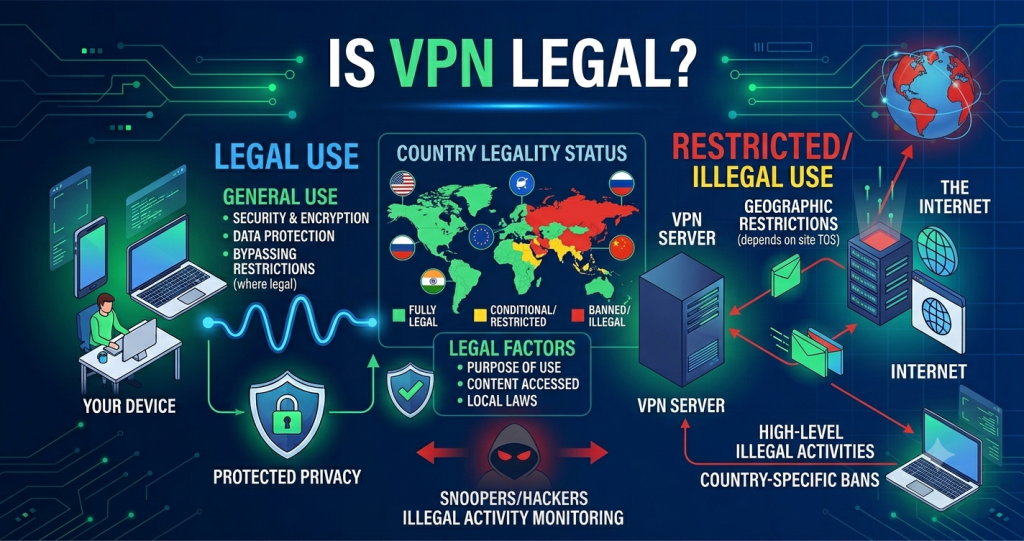
Countries fall broadly into three categories regarding VPN legality:
Category 1: Unrestricted — VPNs Are Fully Legal
The majority of the world. VPNs are used openly by businesses and individuals with no legal restrictions. Governments may conduct lawful surveillance through other means (ISP data retention, metadata logs) but do not restrict VPN technology itself.
Includes: United States, United Kingdom, most of Europe, Canada, Australia, Japan, South Korea, India, most of Africa and Latin America.
Category 2: Restricted — VPNs Are Legal Under Conditions
VPN technology is permitted in principle, but the government imposes conditions: registration requirements, mandatory content filtering, or restrictions on which providers are permitted to operate. Using a non-compliant VPN may be illegal even if VPN technology per se is not banned.
Includes: China (state-approved VPNs only), Russia (registered VPNs only), UAE (legal use cases only), Turkey (periodic blocks), Pakistan (provider registration requirements).
Category 3: Banned — VPNs Are Illegal
VPN use is prohibited outright, typically in countries with the most restrictive internet policies. Enforcement varies widely.
Includes: North Korea, Belarus (banned alongside Tor), Turkmenistan, Iraq (intermittent bans).
4. Countries Where VPNs Are Fully Legal {#fully-legal}
United States
VPN use is fully legal for individuals and businesses. No federal law restricts VPN technology. The U.S. is home to major VPN providers and has strong First Amendment protections for privacy tools.
The primary legal framework governing VPN providers is 18 U.S.C. § 2703 (the Stored Communications Act), which governs when the government can compel service providers to produce user data. Providers with genuine no-logs architectures have successfully argued they have no data to produce. The NSA’s mass surveillance programmes revealed by Edward Snowden in 2013 operate at the backbone level — VPNs do not prevent metadata collection at that scale (EFF, NSA Spying).
United Kingdom
VPNs are legal. The UK operates under the Investigatory Powers Act 2016 (“Snoopers’ Charter”), which requires ISPs to retain browsing metadata for 12 months and grants intelligence agencies broad surveillance powers. VPNs are a legal and popular countermeasure, widely used by businesses and privacy-conscious individuals.
European Union
VPN use is unrestricted across EU member states. The General Data Protection Regulation (GDPR) (Regulation (EU) 2016/679) provides strong data protection rights and incentivises VPN use for lawful privacy protection. EU data retention directives have been repeatedly struck down by the European Court of Justice as disproportionate.
Countries including Germany, the Netherlands, Sweden, and Switzerland have particularly strong privacy cultures and host several of the world’s most reputable VPN providers.
Canada
VPNs are fully legal. Canada operates under PIPEDA (Personal Information Protection and Electronic Documents Act) and participates in the Five Eyes intelligence-sharing alliance. VPN use does not violate Canadian law.
Australia
VPNs are legal. Australia is also a Five Eyes member and operates under the Telecommunications (Interception and Access) Act 1979, which requires ISPs to retain certain metadata. VPNs are widely used and legal.
Japan and South Korea
Both countries have free, open internet environments with no VPN restrictions. Japan and South Korea are among the most internet-advanced societies in the world, and VPN use is unrestricted.
India
VPNs are legal in India, though a 2022 directive from CERT-In (Indian Computer Emergency Response Team) requires VPN providers operating in India to log user data for five years and provide it to authorities upon request (CERT-In Direction No. 20(3)/2022-CERT-In). Several major providers (ExpressVPN, NordVPN, Surfshark) responded by removing their Indian servers entirely, serving Indian users through servers in nearby countries. VPN use itself remains legal.
Most of Africa and Latin America
VPN use is generally unrestricted across Sub-Saharan Africa and Latin America. Notable exceptions with intermittent restrictions include Uganda (which has taxed social media and periodically blocked VPNs during elections) and Venezuela (which has blocked certain VPN protocols during political unrest).
5. Countries Where VPNs Are Restricted {#restricted}
China
The most significant VPN restriction regime in the world. Covered in detail in Section 7.
Russia
Detailed in Section 8.
Iran
Detailed in Section 9.
UAE
Detailed in Section 10.
Turkey
Turkey has a complex relationship with VPNs. The government has blocked specific VPN services and Tor during periods of political tension (particularly following the 2016 coup attempt), but VPN technology is not formally banned. The Radio and Television Supreme Council (RTÜK) has broad censorship powers, and internet blocking has been used extensively against social media platforms. Accessing blocked content via VPN sits in a legal gray zone.
Pakistan
Pakistan’s Pakistan Telecommunication Authority (PTA) issued a directive in 2020 requiring VPN users to register their VPN services with the government (PTA Notification, 2020). Unregistered VPN use is technically illegal, though enforcement against individual users is limited. VPN providers must register to operate legally.
Indonesia
Indonesia has blocked numerous websites and services including gambling, pornography, and at times Reddit and Tumblr. VPNs themselves are not explicitly banned but are used to circumvent blocks, which creates legal ambiguity. The government has periodically threatened VPN restrictions.
Oman
Oman’s Telecommunications Regulatory Authority restricts VPN use. Using a VPN to access blocked content is illegal. Business VPN use for legitimate corporate purposes may be permitted with prior approval.
Saudi Arabia
VPN use to access blocked content is illegal. The government blocks content related to politics, religion, and sexuality. While enforcement against individual users is inconsistent, VPN use for circumventing censorship violates Saudi internet regulations.
6. Countries Where VPNs Are Banned {#banned}
North Korea
Covered in Section 11.
Belarus
Following the disputed 2020 presidential election and subsequent protests, Belarus banned VPNs and Tor alongside a sweeping internet crackdown. The Operational-Analytical Center (OAC) under President Lukashenko enforces strict internet controls. VPN use is illegal and enforcement is active.
Turkmenistan
One of the most closed internet environments in the world. Turkmenistan maintains a state-controlled ISP monopoly. VPNs are blocked at the network level and their use is illegal. Internet penetration in the country is among the lowest globally.
Iraq
Iraq has enacted intermittent VPN bans, typically during periods of civil unrest or examination periods (to prevent academic cheating). The legal status is inconsistent and enforcement is uneven.
Myanmar
Following the 2021 military coup, Myanmar’s junta enacted sweeping internet restrictions including VPN bans. The military government has blocked social media, independent news, and foreign internet services. VPN use is widespread in practice but illegal under junta directives.
7. China: The Great Firewall and VPN Enforcement {#china}
China operates the world’s most sophisticated national content filtering system, known as the Great Firewall (GFW) — formally the Golden Shield Project. Understanding how it works is essential to understanding VPN legality in China.
What the Great Firewall Does
The GFW blocks access to thousands of foreign websites and services including Google (all services), Facebook, Instagram, Twitter/X, YouTube, WhatsApp, Wikipedia, most foreign news outlets, and the majority of VPN provider websites. It operates through:
- IP blocking — blacklisting known IP ranges
- DNS poisoning — returning false DNS responses for blocked domains
- Deep Packet Inspection (DPI) — identifying and blocking VPN traffic signatures
- SNI filtering — blocking HTTPS connections to blocked domains based on the Server Name Indication field in the TLS handshake
- BGP routing manipulation — diverting traffic at the autonomous system level
VPN Legal Status in China
Using an unapproved VPN in China is illegal under the Telecommunications Regulations of the People’s Republic of China and a 2017 Ministry of Industry and Information Technology (MIIT) ruling requiring all VPN providers to obtain government licenses (MIIT Circular, 2017).
State-approved VPNs (operated by China Telecom, China Unicom, and China Mobile) are permitted for business use and route through government-monitored infrastructure. Using them defeats the privacy purpose of a VPN.
Who Gets Prosecuted?
Enforcement is highly selective. Prosecutions typically target:
- VPN resellers and distributors
- Individuals who use VPNs to publish or distribute politically sensitive content
- Businesses operating unapproved VPN services
The average expatriate or business traveller using a personal VPN quietly has historically faced little risk. However, enforcement can intensify around politically sensitive periods (National People’s Congress, Tiananmen anniversary, protests).
A significant crackdown in 2019 saw individuals fined and in some cases detained for VPN use. In 2021, several residents of Xinjiang were prosecuted for VPN use in the context of broader surveillance of the Uyghur population (Human Rights Watch, 2021).
Technical Reality
Despite legal prohibition, tens of millions of Chinese citizens use VPNs daily. The GFW engages in an ongoing technical arms race with VPN providers — blocking known VPN protocols, forcing providers to develop obfuscated protocols (Shadowsocks, V2Ray, trojan) that disguise VPN traffic as normal HTTPS. Standard VPN protocols (OpenVPN, WireGuard, IKEv2) are reliably blocked. Providers with China-capable servers include ExpressVPN, Astrill, and a small number of others.
8. Russia: The Roskomnadzor Regime {#russia}
Russia’s approach to VPN regulation is distinct from China’s outright prohibition: it attempts to co-opt VPNs rather than ban them entirely.
The Legal Framework
Under Federal Law No. 149-FZ and subsequent amendments, Russia’s internet regulator Roskomnadzor requires VPN providers operating in Russia to:
- Register with the government
- Connect to Roskomnadzor’s Federal State Information System (FSIS) to receive and enforce blocklists of prohibited websites
- Block access to sites on the federal registry of prohibited content
In effect, Russia requires VPNs to enforce the same censorship they are typically used to circumvent. VPN providers that comply become government-compliant censorship tools. Providers that refuse are blocked.
The 2017 Law and Its Effects
The 2017 VPN and anonymiser law gave Roskomnadzor authority to block non-compliant VPN services. Most major international providers — NordVPN, ExpressVPN, IPVanish, HideMyAss, and others — refused to comply and were subsequently blocked in Russia (Roskomnadzor official registry).
Following Russia’s invasion of Ukraine in February 2022 and the subsequent blocking of Instagram, BBC, Deutsche Welle, and hundreds of other foreign outlets, VPN downloads in Russia surged dramatically. According to Top10VPN, Russia accounted for a significant share of global VPN demand spikes in March 2022 (Top10VPN Global VPN Usage Report, 2022).
Individual User Risk
For individual Russian citizens, the risk of prosecution for personal VPN use is currently low. Enforcement has focused on providers and distributors, not end users. However, using a VPN to access content deemed extremist or to organise political activity carries significant legal risk under Russia’s broad anti-extremism laws, independent of VPN use.
9. Iran: VPNs Under the Islamic Republic {#iran}
Iran maintains the National Information Network (NIN) — a domestic internet infrastructure designed to function independently of the global internet and facilitate surveillance and censorship.
Legal Status
Under Iranian law, using an unapproved VPN is illegal. Only state-sanctioned VPNs (used by government agencies and approved businesses) are permitted. The government blocks most commercial VPN services at the network level.
Enforcement in Practice
Despite the legal prohibition, VPN use in Iran is extremely widespread — estimates suggest over 30% of the Iranian population regularly uses VPNs to access blocked services including Instagram, Telegram (partially), WhatsApp, YouTube, and foreign news (Freedom House, Freedom on the Net 2023).
During the Mahsa Amini protests of September–November 2022, the Iranian government severely throttled and partially severed internet access, and VPN downloads in Iran spiked by over 3,000% in the days following the initial crackdown (Cloudflare Radar, 2022).
Individual prosecutions for VPN use alone are rare. However, VPN use in conjunction with political organising, protest coordination, or distributing politically sensitive content carries severe legal risk, with prosecutions resulting in lengthy prison sentences.
10. UAE and Gulf States {#uae}
United Arab Emirates
The UAE has some of the most nuanced VPN laws in the Gulf region. VPNs are not banned outright — they are used legally by businesses and the large expatriate community. However:
- Article 9 of Federal Decree Law No. 34 of 2021 prohibits using VPNs to commit or conceal crimes, including accessing content blocked in the UAE.
- Using a VPN to access VoIP services (Skype, WhatsApp calls, FaceTime) — which are restricted in the UAE to protect the revenue of state-owned telecoms Etisalat and du — is technically illegal and can result in fines.
- Accessing pornographic, gambling, or politically sensitive content via VPN violates UAE law regardless of the VPN.
Penalties for illegal VPN use can include fines of up to AED 2 million (approximately $545,000 USD) and potential imprisonment. Enforcement against tourists and short-term visitors has been limited, but business users and residents face more scrutiny.
Qatar
Similar to the UAE — VPNs are in a gray zone. Business use is accepted; using VPNs to access restricted content is illegal. This became particularly relevant during the 2022 FIFA World Cup, when concerns about LGBTQ+ visitors using VPNs to access restricted platforms were widely discussed.
Saudi Arabia
VPN use to circumvent Saudi Arabia’s internet filtering system (which blocks content related to politics, religion, LGBTQ+ topics, and dating services) is illegal. Business VPN use is tolerated. The Communications and Information Technology Commission (CITC) enforces content restrictions.
11. North Korea: Total Digital Isolation {#north-korea}
North Korea presents the most extreme case: the general population has virtually no access to the global internet. The country operates an entirely isolated national intranet called Kwangmyong — accessible to ordinary citizens — containing state-approved content only.
Access to the global internet is restricted to a tiny elite: senior government officials, scientists, and a small number of approved academic and commercial users. These users access the internet through a heavily surveilled state-controlled gateway.
VPN technology is not merely illegal in North Korea — it is practically inaccessible. There is no commercial internet infrastructure through which a VPN could be configured. The concept of individual VPN use simply does not apply in the North Korean context.
For defectors, accessing foreign radio broadcasts or USB drives with foreign media (often smuggled in via the Chinese border) carries severe penalties including forced labour camps (Committee for Human Rights in North Korea, 2023).
12. Legally Gray Zones: VPNs in Ambiguous Jurisdictions {#gray-zones}
Many countries fall into a gray zone where VPN technology is not formally prohibited but its use to access blocked content is implicitly or explicitly illegal.
Egypt
Egypt has blocked hundreds of websites including news outlets, human rights organisations, and VPN provider sites. VPN technology is not formally banned, but using one to access blocked content violates Egypt’s Anti-Cyber and Information Technology Crimes Law No. 175 of 2018. Journalists and activists have faced prosecution.
Ethiopia
Ethiopia has an extensive internet blocking history — blocking social media during political unrest and examinations. VPN use is widespread but legally ambiguous. During the Tigray conflict (2020–2022), internet shutdowns were widespread and VPN use surged.
Kazakhstan
Kazakhstan operates a national content filtering system. Following the 2022 unrest, internet access was severely restricted. VPNs are not formally banned but are used to circumvent state-imposed blocks, placing users in legal ambiguity.
India During State-Level Shutdowns
While VPNs remain legal nationally in India, individual states have imposed internet shutdowns during periods of unrest (notably Jammu & Kashmir, which experienced the world’s longest internet shutdown between 2019–2021). Using a VPN to bypass a state-imposed shutdown creates legal ambiguity even though VPNs themselves are not prohibited.
13. Legally Using a VPN Does Not Make Illegal Acts Legal {#illegal-acts}
This is perhaps the most misunderstood aspect of VPN legality, and it deserves direct, unambiguous treatment.
A VPN is a privacy tool — not a legal shield.
If an act is illegal without a VPN, it remains illegal with one. The VPN may make the act harder to attribute to you, but it does not change the legal status of the act itself.
Examples of illegal activities that VPNs do not legalise:
- Copyright infringement — Downloading pirated content through a VPN violates copyright law in jurisdictions that prohibit it, regardless of the VPN.
- Cybercrime — Hacking, deploying malware, running DDoS attacks, credential stuffing, or any other cybercrime remains illegal regardless of VPN use.
- Child sexual abuse material (CSAM) — Accessing or distributing CSAM is a serious crime in every jurisdiction. VPNs provide no meaningful legal or practical protection given the priority law enforcement places on CSAM investigations.
- Fraud and financial crime — Using a VPN to commit wire fraud, money laundering, or circumvent financial sanctions does not create a legal defence.
- Drug trafficking and darknet markets — Ordering controlled substances through a VPN (including via Tor and darknet markets) does not legalise the purchase or possession.
- Terrorism and extremism — Using a VPN to access, create, or distribute terrorist content violates laws in virtually every jurisdiction.
How Law Enforcement De-Anonymises VPN Users
VPN users are not invisible. Law enforcement has multiple avenues for identifying suspects who use VPNs:
Payment records — If you paid for a VPN with a credit card, bank transfer, or PayPal, your identity is linked to the account. Law enforcement can subpoena payment processors.
Provider cooperation — Despite no-logs claims, some providers have cooperated with authorities. In 2011, HideMyAss provided user logs to the FBI in a high-profile hacking case. No-logs providers with RAM-only servers have stronger protections, but provider trust is never absolute.
Endpoint compromise — If your device is compromised (malware, law enforcement-installed tools), traffic can be captured before it enters the VPN tunnel.
Traffic correlation — Sophisticated adversaries can analyse traffic patterns entering a VPN network and exiting it to correlate users with their activity — the same technique used to de-anonymise Tor users in some cases.
Operational security failures — Most VPN users who face prosecution make operational security errors: logging into personal accounts while using a VPN, using non-anonymous payment methods, or making statements that link their real identity to their online activity.
14. VPNs and Copyright Law {#copyright}
Copyright and VPN use intersect primarily around two activities: accessing geo-restricted streaming content and file sharing.
Geo-Restricted Streaming
Streaming services such as Netflix, BBC iPlayer, Disney+, Hulu, and others license content on a territorial basis. Content available in the US Netflix library may not be licensed for the UK, and vice versa. Using a VPN to access a content library you’re not geographically entitled to may violate the streaming service’s Terms of Service.
However — and this is an important distinction — violating a platform’s Terms of Service is not a criminal offence. It is a breach of contract between you and the service provider. The consequence is typically account suspension or termination, not criminal prosecution.
No individual consumer has been criminally prosecuted for using a VPN to access a different regional streaming library. It is a civil matter between you and the platform.
Torrenting and P2P Copyright Infringement
Downloading or distributing copyrighted content via BitTorrent without authorisation is copyright infringement in most jurisdictions, regardless of VPN use. The VPN may prevent your ISP from seeing the activity and prevent your IP address from appearing in torrent swarm logs — but it does not make the activity legal.
Copyright holders and their monitoring organisations (such as Rightscorp and MUSO) monitor torrent swarms for IP addresses. A VPN prevents your real IP from appearing, but exposes the VPN server’s IP. Some VPN providers have received DMCA notices for their IP ranges. Reputable providers do not forward these to users (and cannot, if they maintain a genuine no-logs policy).
In the EU, the Copyright in the Digital Single Market Directive (Directive 2019/790) has introduced stronger platform liability provisions, though individual user enforcement remains limited in practice.
15. VPNs and Workplace or School Policies {#workplace}
Your employer or educational institution may prohibit VPN use on their networks, even in countries where VPNs are fully legal. This is an acceptable use policy matter, not a legal one — but it can have employment or disciplinary consequences.
Workplace Networks
Many corporate networks use transparent proxies, deep packet inspection, and endpoint monitoring that can detect VPN usage. Using a personal VPN on a corporate device or corporate network to bypass monitoring may violate your employment agreement and constitute grounds for disciplinary action.
Corporate VPNs (used to access internal company resources remotely) are a separate matter — they are standard and expected. The prohibition typically applies to using a personal VPN to route around corporate monitoring.
Educational Institutions
Schools and universities frequently restrict VPN use on their networks to enforce content filtering policies or prevent bandwidth abuse. This is a policy matter governed by the institution’s acceptable use policy, not by law.
In both cases, the appropriate recourse is to review your institution’s policies before using a VPN on their infrastructure.
16. VPN Provider Jurisdiction and Data Requests {#provider-jurisdiction}
Where your VPN provider is incorporated determines which country’s laws govern data requests, compelled disclosure, and user privacy.
Five Eyes, Nine Eyes, Fourteen Eyes
The Five Eyes (US, UK, Canada, Australia, New Zealand) intelligence-sharing alliance has historically been a concern for privacy-conscious VPN users. These governments share intelligence — including potentially user data obtained from service providers — with each other. Similar (but less formal) sharing agreements extend to Nine Eyes (+ France, Denmark, Netherlands, Norway) and Fourteen Eyes (+ Germany, Belgium, Italy, Spain, Sweden).
A VPN provider incorporated in the US is subject to US law, including National Security Letters (which can compel disclosure with a gag order preventing the provider from notifying the user) and FISA court orders.
However, the practical impact of jurisdiction is significantly mitigated by a genuine no-logs policy: if the provider retains no user data, there is nothing meaningful to compel. A US-based VPN with a RAM-only, no-logs architecture is arguably more private in practice than a Panama-based VPN that logs everything.
Jurisdiction matters less than logging policy.
Privacy-Friendly VPN Jurisdictions
| Jurisdiction | Key Feature | Notable Provider |
|---|---|---|
| British Virgin Islands | Not part of Five Eyes; no mandatory data retention | ExpressVPN |
| Panama | Not part of intelligence alliances; no data retention laws | NordVPN |
| Switzerland | Strong privacy laws; not EU; not Five Eyes | ProtonVPN |
| Sweden | EU member; GDPR protections; strong rule of law | Mullvad |
| Malta | EU GDPR jurisdiction; strong privacy culture | Private Internet Access |
Real-World Government Requests
The most credible evidence of a VPN’s no-logs policy is not the policy itself — it is what happens when they receive a legal request:
- NordVPN (2018): Following a Finnish server compromise, forensic investigation confirmed no user logs existed to extract.
- ExpressVPN (2017): Turkish authorities seized an ExpressVPN server in connection with the investigation of the Russian ambassador’s assassination. No relevant user data was found.
- Mullvad (2023): Swedish police raided a Mullvad server location. No user data was obtained because Mullvad maintains RAM-only servers with no logging.
These real-world tests provide stronger assurance than any privacy policy.
17. What Happens If You’re Caught Using an Illegal VPN? {#caught}
The consequences of illegal VPN use vary dramatically by country and context.
Fines
The most common penalty in countries where VPN use is restricted (rather than banned) is a financial fine. In the UAE, fines can reach AED 2 million. In China, fines for VPN use without formal prosecution are common. In Russia, VPN providers face fines for non-compliance; individual users face lighter consequences currently.
Device Seizure
In countries with active internet enforcement (China, Iran, UAE), border control agents may inspect devices and check for VPN applications. Devices may be searched, and VPN apps may be required to be deleted.
Imprisonment
In the most extreme cases — typically involving using a VPN in conjunction with politically sensitive activity, journalism, or protest organising in authoritarian states — imprisonment is a real risk. In China, individuals have been sentenced to prison for VPN reselling. In Iran, activists who used VPNs to coordinate protests have been imprisoned for the underlying political activity, with VPN use cited as an aggravating factor.
Employment Consequences
In workplace contexts in otherwise permissive jurisdictions, unauthorised VPN use on corporate infrastructure can result in disciplinary action up to and including termination.
Practical Risk for Travellers
For most tourists and business travellers visiting restricted countries (including China), the practical risk of using a personal VPN for routine privacy purposes is low — particularly if:
- The VPN is installed before entry (VPN provider websites are often blocked in-country)
- The VPN uses obfuscated protocols (standard protocols are actively blocked)
- The user avoids using the VPN for activities that draw political attention
The legal risk is real but enforcement against foreign visitors for personal VPN use has historically been limited.
18. How to Choose a VPN for Legal Compliance {#choosing}
When selecting a VPN with legality and jurisdiction in mind, evaluate the following:
No-Logs Policy with Independent Verification
The single most important factor. Look for:
- A detailed, specific no-logs policy (not vague marketing language)
- Independent audits by recognised security firms (Cure53, PwC, KPMG, Deloitte, Assured)
- Real-world proof: government requests that yielded no data
Jurisdiction
Prefer providers incorporated outside Five Eyes jurisdictions and in countries with strong privacy laws and no mandatory data retention. But remember: a no-logs provider in the US is more private than a logging provider in Panama. See our related guide: How Does a VPN Work?
RAM-Only Infrastructure
RAM-only (“diskless”) servers ensure that no data persists beyond a reboot. Server seizure yields nothing. This is the strongest architectural privacy guarantee available.
Transparency Reports and Warrant Canaries
Look for annual transparency reports disclosing the number and nature of legal requests received, and how they were handled. A warrant canary — a regularly updated statement confirming no secret government orders have been received — provides additional assurance, within its limitations.
Payment Anonymity
For maximum legal insulation, choose a provider that accepts cryptocurrency (particularly Monero, which is privacy-preserving) or cash payments. Mullvad accepts both and does not require an account email address — offering genuine financial anonymity.
Obfuscation for Restricted Jurisdictions
If you’re travelling to or residing in a country where standard VPN protocols are blocked (China, Russia, Iran), choose a provider with obfuscated protocol support: Shadowsocks, V2Ray, NordVPN’s obfuscated servers, ExpressVPN’s Lightway with obfuscation, or similar.
For the cost considerations around free vs. premium VPNs in this context, see: Free VPN vs. Paid VPN
19. Frequently Asked Questions {#faq}
Is using a VPN illegal in the US?
No. VPNs are fully legal in the United States. There are no federal or state laws restricting their use. VPNs are widely used by businesses, remote workers, and privacy-conscious individuals across the country.
Can I get in trouble for using a VPN?
In most countries, no. In countries where VPNs are restricted or banned (China, Russia, Iran, UAE, Belarus), you could face fines or other consequences depending on how and why you’re using the VPN. Using a VPN to commit illegal acts can also expose you to prosecution for those acts — the VPN does not provide legal immunity.
Does a VPN make me anonymous?
A VPN significantly improves your privacy — it hides your IP address from websites and encrypts your traffic from your ISP. However, it does not make you fully anonymous. Your VPN provider can see your traffic, your real identity can be linked through payment records, browser fingerprinting can identify you regardless of IP, and traffic correlation attacks are possible by sophisticated adversaries.
Is it illegal to use a VPN to watch Netflix from another country?
In most jurisdictions, no — it is a violation of Netflix’s Terms of Service (a civil matter between you and Netflix), not a criminal offence. Netflix may suspend or terminate your account, but no individual consumer has been criminally prosecuted for accessing a different regional Netflix library.
Can my ISP see that I’re using a VPN?
Yes — your ISP can see that you’re sending encrypted traffic to a VPN server’s IP address. They cannot see the content of that traffic or which websites you’re visiting. In some countries, using a VPN itself may be reported to authorities by ISPs.
Do I need a VPN if I use Tor?
Tor provides stronger anonymity than a VPN but is slower and more detectable. Using a VPN before Tor (VPN over Tor) hides your Tor usage from your ISP and prevents the Tor entry node from seeing your real IP. Whether this combination is necessary depends on your threat model.
Can the government track me through a VPN?
Sophisticated nation-state intelligence agencies have traffic analysis capabilities that can potentially de-anonymise VPN users. For most users with typical threat models, a quality no-logs VPN provides very strong protection against government-level surveillance conducted through ISPs and standard legal channels. Highly targeted law enforcement operations with full legal authority are a different matter.
Is it legal to use a VPN at work?
It depends on your employer’s acceptable use policy. Using a personal VPN on personal devices during work hours is typically legal. Using a personal VPN on corporate devices or corporate networks may violate your employment agreement. Review your workplace policy before using a personal VPN on any corporate infrastructure.
Should I use a free VPN for privacy?
For genuine privacy — particularly in contexts with legal implications — a free VPN is not adequate. Free VPNs frequently log user data, sell browsing history to advertisers, use weak encryption, and lack the legal and technical infrastructure that makes a no-logs claim credible. See our full analysis: Free VPN vs. Paid VPN
The Bottom Line
VPNs are legal tools used by hundreds of millions of people worldwide for legitimate privacy, security, and access purposes. In the vast majority of countries, you can use a VPN freely and legally. Where restrictions exist, they are almost always in the context of authoritarian governments seeking to control information access — not democratic governments concerned about ordinary privacy.
The key principles to carry away:
- Check your jurisdiction before using a VPN in an unfamiliar country
- A VPN does not legalise illegal activity — it only affects attribution, not the legal character of the act
- Provider trust matters — choose providers with audited no-logs policies and RAM-only infrastructure
- Obfuscation is essential in heavily censored environments
- Payment anonymity provides an additional layer of legal insulation in high-risk contexts
To continue building your understanding:
- What Is a VPN? — Foundational overview of VPN technology
- How Does a VPN Work? — The complete technical breakdown
- VPN vs. Proxy — Understanding the tools and their differences
- Free VPN vs. Paid VPN — Why free VPNs fall short for serious privacy needs
Last updated: June 2026. Laws and enforcement practices change frequently. For specific legal advice regarding your jurisdiction or circumstances, consult a qualified legal professional.